I still remember the moment I tore my ACL playing intramural basketball in college. I was doing the same movement I had done 1,000 times before, and my knee just gave out.
My initial reaction was, this couldn't happen to me.
The next step was an MRI to confirm what the athletic trainer had feared. My ACL was torn, and I needed ACL reconstruction surgery.
I went through the initial stages of grief that Jen Lawlor recently discussed on our Core Sport: Between Sets podcast: denial, anger, sadness, and finally, acceptance.
Looking back, I believe my own injury and recovery process has helped me understand the importance of celebrating the small wins throughout ACL rehab. Now, as a physical therapist and the owner of Core Sport + Physical Therapy in Evergreen Park and Downers Grove, Illinois, I try to discuss these goals and "wins" with my patients throughout their recovery.
One thing I always emphasize is that everyone's ACL rehab journey is different. Comparing your timeline to a friend, teammate, or professional athlete can actually take away from your own progress.
There are several factors that can affect your ACL recovery timeline, including graft choice, additional injuries such as a meniscus repair that may delay weight-bearing or range of motion, how much prehab you completed before surgery, your age, previous muscle mass, strength, and overall movement quality.
For that reason, this blog isn't meant to give you an exact ACL rehab timeline. Instead, I want to focus on some of the criteria and small wins we look for at Core Sport + Physical Therapy as we progress an athlete through the earlier stages of physical therapy after ACL surgery.
The Early Wins: Getting Your Knee Back After ACL Surgery
The first few weeks after surgery can be a grind. Between the pain, swelling, limited mobility, and being cooped up in your house, it can take a toll on you both physically and mentally.
That makes the early wins even more important.
The first major win in our ACL rehab journey is getting your knee fully straight.
Ultimately, we want the surgical knee to match the opposite side when it comes to range of motion. We have various tricks and exercises to help achieve this goal, and I still remember the dreaded prone hangs throughout my own rehab journey. Thankfully, we have some more comfortable variations at Core Sport. (video of knee extension prolonged hang with weight)
Getting your knee fully straight may not seem exciting, but it is a major early milestone in ACL rehab and should be celebrated as such.
The next major win is performing a straight leg raise without assistance.
After ACL surgery, one of the earliest challenges is something called arthrogenic muscle inhibition (AMI). In simple terms, swelling, pain, and the trauma from surgery can interfere with the signals between your knee, brain, and quadriceps. Your quad may have been incredibly strong before surgery, but suddenly you can't get it to contract normally.
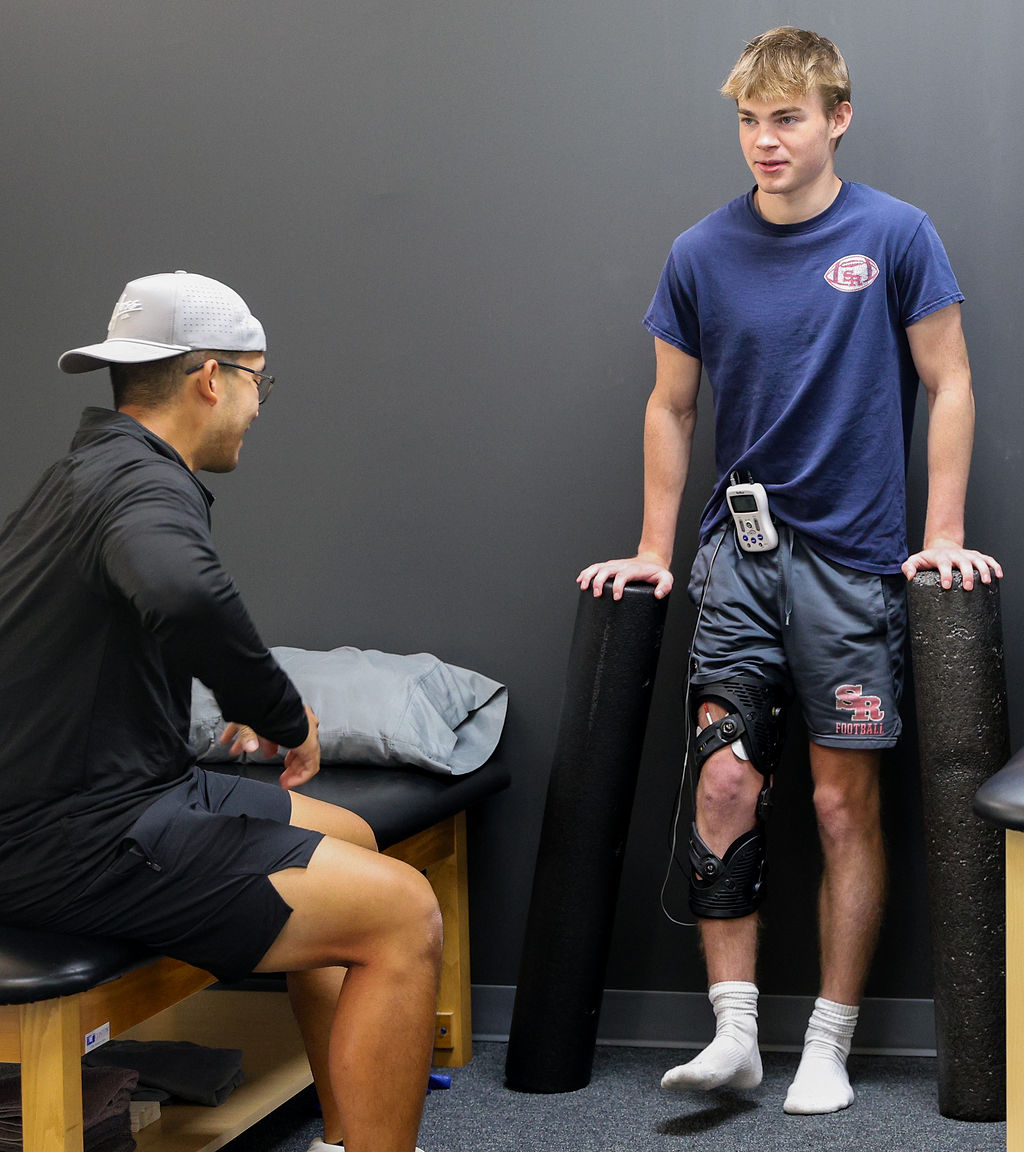
Early ACL rehab focuses heavily on getting that quad working again. We use swelling management, quad activation exercises, neuromuscular electrical stimulation, and progressive loading to help restore that connection. One new exercise we have been working on is a standing straight leg raise ISO. We can use this exercise with electrical stimulation and it provides a gravity eliminated position to create an easier movement while focusing on fully straightening the knee (Jared SLR video standing)
Performing your first straight leg raise without assistance may seem like a small win, but it is an important step in the ACL recovery process—and a small step toward walking without crutches (no pun intended).
Bending your knee to 90 degrees is also a win.
Some athletes experience more muscle guarding than others, which can make bending the knee surprisingly difficult. Your body is essentially trying to protect the knee, and sometimes we need to gradually convince it that movement is safe again.
Some surgeons may prescribe a Continuous Passive Motion (CPM) machine to help you continue working on motion at home.
One of my go-to exercises for restoring passive knee flexion can be seen here:
I like this variation because it is gentle, your therapist can easily see how you react to the movement, and gravity helps the leg relax. It can also easily be performed at home by scooting forward toward the edge of your bed, chair, or recliner and allowing the knee to gradually bend as you keep your foot on the ground and scoot forward.
We may also perform hands-on techniques to the quadriceps or use a massage gun to provide different sensory input around the knee and help decrease guarding.
From 90 degrees, we work toward 100, then 120, and eventually toward matching the non-surgical knee.
Again, don't compare yourself to someone else's timeline. Procedures performed alongside the ACL reconstruction can change these goals. For example, certain meniscus repairs may require temporary restrictions on knee flexion or weight-bearing to protect the healing tissue.
Walking Without Crutches After ACL Reconstruction
The first question many of our athletes ask is:
"When can I walk without crutches?!"
This is a nuanced answer in my book. Sometimes I prefer athletes to continue using crutches even after they begin coming out of their knee brace.
My thought process is pretty simple: I'd rather see a normal gait pattern with crutches than an abnormal gait pattern without them.
Regardless, getting rid of the crutches is a huge goal in ACL rehab.
Before we get there, we like to see a strong quadriceps contraction and the ability to perform a straight leg raise without a knee extension lag—meaning the knee stays completely straight as you lift the leg off the table. We like to see you perform around 20 straight leg raises to see you have the strength and endurance.
We use electrical stimulation, various quadriceps activation exercises, and a walking progression that may include hurdles, gait retraining, and exercises that retrain the timing and coordination of the muscles around the knee.
Eventually, you take those first normal steps without the crutches.
That's another win.
Hitting Strength Goals: Rebuilding Your Quad After an ACL Tear
The quadriceps are arguably the most important muscle group to rebuild following an ACL injury.
They are often weak because of the AMI we discussed earlier, but weakness can also be influenced by the type of graft used during surgery. Common ACL graft choices include patellar tendon, quadriceps tendon, hamstring tendon, and allograft (cadaver tissue). Graft selection depends on the athlete, surgeon, sport, age, and several other factors.
When tissue is harvested from around the knee—particularly with patellar tendon and quadriceps tendon grafts—we can see significant quadriceps weakness, inhibition, and pain that can make rebuilding strength challenging.
That's why progressively loading the quadriceps is such an important part of ACL rehab.
One tool we frequently use early in this process is blood flow restriction training (BFR). BFR allows us to challenge the muscle using relatively light weights while partially restricting blood flow to the working limb. This creates a significant training stimulus without requiring the heavy loads we would normally need to build muscle and strength. Early after surgery, when the knee may not tolerate heavy resistance yet, this can be extremely useful.
As the knee progresses, we gradually introduce more load.
We use our Keiser knee extension machine—often beginning around four weeks after surgery depending on the individual—along with various isometric exercises, squats, lunges, split squats, and eventually heavier single-leg strength exercises.
The goal isn't to throw as much weight as possible at the knee.
The goal is to progressively overload the surgical leg enough to create strength adaptations without constantly irritating the knee or graft harvest site.
This is also where objective testing becomes extremely valuable.
At Core Sport, we utilize VALD performance technology to measure strength throughout the ACL rehab process. We commonly assess knee extension and knee flexion strength around the 14–16 week mark, although that timeline can change depending on the athlete and their surgery.
One number we look at is called the Limb Symmetry Index, or LSI.
Despite the fancy name, the concept is simple.
We compare the strength of your surgical leg to your non-surgical leg. If your surgical leg produces 70 pounds of force and your other leg produces 100 pounds, your LSI is 70%.
In other words, your surgical leg currently has about 70% of the strength of the other side.
Around this stage of rehab, seeing quadriceps strength reach roughly 60–70% LSI can represent a meaningful milestone. That number isn't a universal pass/fail standard, and the timeline can shift depending on pain, swelling, graft choice, weight-bearing restrictions, additional procedures, and the athlete's starting strength.
But when one of our athletes hits that 60–70% range after spending months rebuilding their quad?
That's a win. Celebrate it.
And be prepared for a back slap before testing.
IYKYK.
Returning to Running After ACL Surgery
Then comes one of the milestones almost every athlete remembers:
The first time you jog again.
Many other facilities and surgeons recommend a time-based progression to determine when athletes are able to begin a jog program. However, we use strength testing and a battery of other tests to determine when an athlete is strong enough to begin a return-to-running program. One measurement is 60–70% on quad strength testing, a "quiet knee", ability to tolerate single leg squats, single leg calf raises, and having begun force absorption exercises to ensure your knee is ready to tolerate the impact of jogging.
ACL rehab is a long journey. Celebrate the small wins. Stack enough of them together, and they become major victories.
From ACL Rehab to Return to Sport
These are a few of the early milestones we look for during the ACL journey. Reaching them doesn't mean the rehab process is finished. Instead, they help build the foundation for the next phase.
As strength, movement quality, confidence, and tolerance to higher-level activity improve, our focus begins to shift from traditional rehabilitation toward return to performance. This is where we can start introducing more advanced plyometrics, acceleration and deceleration, change of direction, reactive movement, and drills that reflect the specific demands of an athlete's sport.
At Core Sport, this progression allows our physical therapists to work alongside our sports performance staff who specialize in return-to-sport training, including advanced jumping and landing progressions, cutting, speed development, and sport-specific movement.
Returning from an ACL injury isn't defined by one exercise, one test, or one date on the calendar. It is a progression of milestones that build on one another—from restoring motion and strength early in rehab to eventually preparing the athlete for the speed, force, and unpredictability of sport.
Keep stacking the wins.
